Media Response

On all sides of the political spectrum, Facebook was facing a negative response. There was an internal struggle with the response from top officials with regards to the situation and a hesitancy to release any information immediately. While the exact extent of information known prior to the public release is unknown, it is easy to understand why media outlets would be concerned. Media outlets on the left side of the political spectrum were the first to display outrage, as they claimed the Russian Ads contributed to Donald Trumps 2016 campaign and were created in an effort to support the election of the Republican Candidate. Major media outlets such as The New York Times, The Washington Post, CNN, Fox News, NBC, and NPR all released articles in response to the situation around the late summer to mid fall of 2017. What is surprising is that initially the situation receives bipartisan support, even resulting in a congressional testimony and questioning with Facebook CEO Mark Zuckerberg. However, over time the issue gains less support from Republican and Conservative news sources as allegations increased revolving around President Donald Trump and a relationship with Russia.

Let’s take a look at some specifics on both sides of the political spectrum as well as some of the more centered approaches to the issue.

A December of 2018 NBC Article Headline suggests that Russia favored Trump in the election.
A September 2018 New Yorker Headline states that Russia helped Trump win the 2016 election.

The articles above are examples of more left-leaning reports regarding the Ads and posts created by Russian Hackers. These articles serve to directly connect the election of Donald Trump to the Russian-based postings. By comparison, the left has much more coverage and is working much more actively to investigate the relationship. This may be a result of supposed connections between the Russian hackers and Donald Trump. While the significance of the posts is certainly concerning as well as the political influence, some may say that to correlate the number of posts directly to the amount of votes Hilary Clinton lost by may be a bit crass, at least at the time of it’s posting.

A November 2017 Fox News Article displays concern as well as anger over the situation.

Fox News, a notoriously right-leaning news outlet displayed equal concern, however with a slightly different tone than those on the left side of things. For these media outlets, they rarely mention that these Russian Ads favored Donald Trump and instead focus more heavily on how the posts were created to promote divide and how Facebook was slow to respond. The posts on right-winged news sources simply never mentioned that there could possibly be any connection to the possibility of the posts aiding Donald Trump, while the left focused very heavily on the topic. Overall, there is much less coverage on the right and it is clear to see that the left is most specifically upset by the posts and ads.

Perhaps in the center of all of this is the White House and Congress themselves post-testimony of Mark Zuckerberg, as well as many articles from The New York Times and Washington Post. What is to be taken away from the testimony and questioning of the CEO is that there is a growing bipartisan concern for how to prevent these issues in the future. Officials and representatives on both sides displayed concern as well as a level of anger and confusion as to what exactly is happening. The most centered approaches to the issue are those simply stating the facts about what happened and then providing information as to what Facebook is doing now. I will say that it is extremely difficult for certain parties to stay neutral during this time, as more information is coming out regarding possible Trump ties to Russia as well as a Mueller probe sitting in limbo.

Sources

What Should Impossible Do?

Overall, Impossible has a reasonable stance on the environmental issues that they are dealing with – they were founded on the idea of saving the environment, after all. I think they should continue on the path they have paved already. If they continue forward, they will undoubtedly succeed.

Image result for question mark

While their course of action is generally the same, they can accomplish their goals in any order. The two most important goals that I think they need to complete to succeed are creating new types of plant based meat such as other forms of beef, fish, and other animals, and increasing their production capabilities in order to lower the cost of their product for consumers.

Image result for meat

In the branch of developing new ways to produce meats and fish, this would be beneficial to everyone, as it would allow for more variety, bringing more people into the market. However, just developing a successful burger has taken years of research and development, so this would be a ways off.

I believe that increasing their production capabilities to allow for cheaper costs to the consumer would be a more achievable goal in the near future. With production ramped up, more burgers could be sent all over the world, and if it becomes cheaper than beef, while also tasting just as good, it will really bring in interest from the general consumer. Then, once the market has become saturated with filled customers, Impossible will have the capital and time to begin developing new products, which would likely be just as cheap as their other products, now that production is at a much larger scale.

Image result for cost lower

From this, I feel that making sure that their product is cheap and available to all is the goal they should strive to achieve first and foremost. From this, they will raise awareness of their cause, which people will spread to their friends and family, helping save the Earth in the process.

What does everyone else say about Impossible?

There are many different restaurants that you can purchase the Impossible burger in. In fact, on November 13, 2018, you could walk into any participating Dave and Busters and get an Impossible Burger with fries, on the house. I was able to attend this, and it was very exciting to get to try this burger firsthand, without having to spend a dime. the burger surprisingly had a texture and flavor very similar to real meat.

Image result for free impossible burger dave and busters

Reception to this event was generally widely received, as who could really complain about getting a free burger? Many larger burger chains have also decided to pick up the burger, such as Red Robin, Umami Burger, and White Castle(in slider form). On April 1st of 2019, Impossible announced they were bringing the burger to Burger King as a test in the St. Louis area, and would expand it to all locations if it did well.

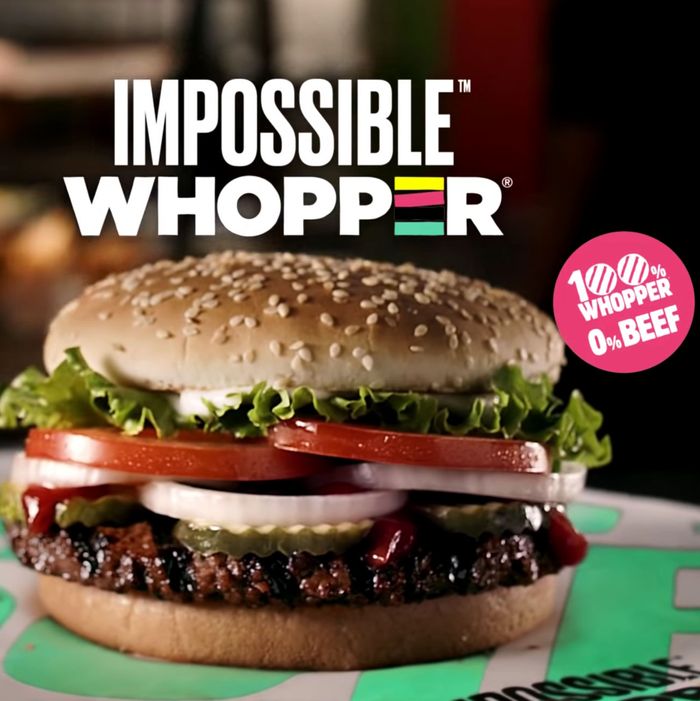
Image result for impossible whopper

This Impossible Whopper has not had entirely positive reception. Some are claiming that this test will not do well, as nobody will want to purchase it due to it having a $1 premium against the regular whopper. Burger King is pushing the ecologic value of the burger, but getting people to try something they might not like while also making them pay more is not a recipe for success.

Another complaint for the company is the rebuttal it received from the FDA. The company decided to send a letter to the FDA with data they had, saying that they felt the protein they created was safe. When the FDA responded, they claimed that the data presented did not show that the protein was safe to consume. Impossible responded with an even longer response, with over 1,000 pages of data, and took the burger to market without the FDA’s all clear. Some even argue that not a long enough period of testing was done in order to ensure safety, as heme consumption was only measured on mice for 2 months.

Overall, the reviews are mixed, but I think they will improve over time. The burger is a technological marvel that has not been eaten before in human history, but it requires more engineering in order to decrease in price and to allow more people to buy into it.

Sources:
https://www.foodandwine.com/news/impossible-burger-red-robin

https://www.bloomberg.com/news/articles/2019-04-01/burger-king-tests-plant-based-meat-with-an-impossible-whopper

http://www.grubstreet.com/2018/06/impossible-burger-health-controversy.html

The Path Forward for Boeing

Boeing’s Courses of Action and Ethical Frameworks

After this crisis, Boeing’s primary objective should be to regain trust in every stakeholder; airlines, governments and passengers need to be assured that the Boeing 737 MAX aircraft they are flying are safe. Furthermore, passengers need to know that Boeing’s highest priority is safety and that pilots are fully prepared to deal with the new aircraft.

_105965796_et-avj1.jpg
Ethiopian Airlines 737 MAX before crash


With the battering of their reputation, Boeing will not have an easy path forward. CEO of Boeing, Dennis Muilenburg, gave an address to the world detailing the preliminary reports that the MCAS system were a primary factor in both crashes. Now, it is imperative that Boeing partner with their stakeholders to develop a path forward for the re-introduction of the 737 MAX to service. Following a teleological approach, Boeing has moral obligation to do what is “right”. I believe this framework gives the best path forward with honoring the lives lost of the two disasters and works to protect the future.

Why this Approach is the Best

The Teleological approach reins supreme in defining a path forward for Boeing for a multitude of reasons. Boeing needs to implement a utilitarian approach for their 737 MAX crisis as they are responsible for the lives of anyone who steps on their aircraft. Though this approach will cost stakeholders such as airlines and airports a lot of money in dealing with the 737 MAX grounding, it is superior to having the possibility of an accident.

Other Potential Approaches for Boeing

Boeing could consider utilizing a deontological approach as it is their “duty” to quickly fix the 737 MAX and safely return it to service. Immanuel Kant’s argument to act with one’s “duty” provides for a less clear path forward as the corporation’s duty is to maximize shareholder returns, not necessarily in the best interest of the consumer. This is a possible alternative approach, but not the best one as Boeing needs to put safety, not profits first. With the rush to market of the 737 MAX and extra cost for more safety features to compensate for the MCAS system, Boeing has been shown to prioritize profits over people. For Boeing, there is a long flight ahead.


References

https://www.cnn.com/2019/04/07/politics/boeing-aviation-737-max-aftereffects/index.html

https://liveandletsfly.boardingarea.com/2019/03/11/boeing-737-max-8-safety-statement/


Media Response to the 737 MAX Crisis

Global Outcry

Over the past generation, American citizens have enjoyed safe and nearly accident-free air travel. Technological advancements in aircraft design have enabled far greater safety in global aviation. Governmental departments such as the Federal Aviation Administration (FAA) regulate the industry to maintain our trust in ensuring the safety of aircraft and airspace we

Picture1.png
President Trump delivering address during the launch of the Boeing 787 jetliner

use. With the recent disasters of the 737 MAX aircraft, the international media response has brought to light many differing opinions as information about the parallels of the crashes come to light.

Regulatory Oversight Concerns

Boeing is well-known for their close ties with the United States Government. The Atlantic begs the question whether the FAA was right in delaying the grounding of the 737 MAX, or if it “was it being politically, nationalistically, or commercially swayed?” (Fallows) From a regulatory perspective, the close-knit relationship Boeing has maintained with the U.S. regulatory authorities can be concerning. In addition, the FAA has allowed a considerable amount of safety checks and regulatory procedures to be done by the company itself, not a governmental agency.


Aviation Safety Reporting System

Mr. Fallows editorial in the Atlantic goes on to discuss Nasa’s Aviation Safety Reporting System (ASRS) in regard to 737 MAX incidents. Several of these reports detailed the MCAS system lowering the nose of the plane and that the pilots overrode the system. Even though these planes didn’t crash, the pilots had to disable or override the MCAS system to prevent the plane from tilting down and possibly crashing.


Investigation into Pilot Emergency Protocols

The Wall Street Journal details the pilot response to the Ethiopian Airlines crash. The crew disengaged the MCAS system, but re-engaged it shortly after, going against Boeing emergency protocol.

Picture1.png
Grounded Boeing 737 MAX aircraft in Southwest Airlines livery

Also, the pilot re-engaged autopilot when the plane was producing audible warning signals that would have a pilot not engage the system.


Opinion on the International Media Response

I believe that both editorials and news complement each other to enable great insight into the essence of a subject. With extensive opinions about Boeing’s ethical wrongdoings in regard to the 737 MAX, it is intriguing to see how government and private industry respond to the crisis. Boeing customers such as Norwegian Airlines are seeking damages against Boeing for the cost of grounding their 737 MAX fleet.


Furthermore, I also believe that the media response will paint the picture of Boeing’s involvement in the accidents for victim families. If it can be proven that Boeing had sufficient information on the MCAS system’s flaws before the accidents occurred, then Boeing could be liable for punitive damages from the families of victims. This series of accidents is unprecedented in the history of Boeing. Should it be concluded that Boeing knew about these mechanical and technological shortfalls of the 737 MAX aircraft, the entire industry will have a reckoning like never before.


References

https://www.theatlantic.com/notes/2019/03/heres-what-was-on-the-record-about-problems-with-the-737-max/584791/

https://www.wsj.com/articles/as-flight-control-system-is-blamed-for-boeing-crash-pilots-actions-also-prompt-questions-11554761918


Boeing’s Response to the 737 MAX Crisis

Crisis Response

In the aftermath of the two accidents, the CEO of Boeing, Dennis Muilenburg, addressed the public through a video on Boeing’s website. Mr. Muilenburg expressed his sorrow for the lives lost on Lion Air #610 and Ethiopian Airlines #302. He acknowledged that “it’s apparent that in both flights the Maneuvering Characteristics Augmentation System, known as MCAS, activated in response to erroneous angle of attack information.” (Muilenburg) He then went on to discuss similarities of these two accidents to most other air crashes in that they are typically caused by a chain of events. He did, however, acknowledge that Boeing “owns” the risk associated with the flight of their jetliners

Picture1.png
Dennis Muilenburg in his address about the 737 MAX crashes

Boeing’s Explanations of their Actions

Boeing has expressed that their top engineers have been working in collaboration with the Federal Aviation Administration to roll-out a software update to prevent future accidents. It was promised that Boeing has taken action to introduce this update as soon as possible and that they regret the inconveniences caused to the global aircraft market.

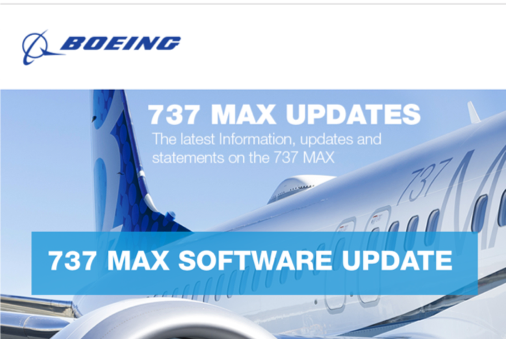
Boeing now maintains a website page detailing their efforts into the software update to correct the malfunctioning MCAS system. The new pilot training accompanying the software update accompanies information on the 737 MAX flight deck displays with a focus on the angle of attack indicator. The extensive testing on the MCAS software is emphasized, along with Boeing’s unwavering commitment to safety.

Opinion on Boeing’s Approach to the 737 MAX Crisis

Given the information of several greedy choices Boeing made in rushing the 737 MAX to the skies, Boeing’s actions to minimize the perceived impact of the incidents as much as possible is the only natural step. Boeing has a long journey ahead of them to restore public confidence and trust in them.

2.png
Page on Boeing’s website detailing the 737 MAX software update

In 2018, Boeing was named one of Fortune Magazine’s “World’s Most Admired Companies”. The revelations from these incidents have led to a steep descent from grace. On a personal note, I am embarrassed on behalf of the U.S.; Boeing has a rich history of American aviation elevating the world to flight and their tarnished reputation reflects poorly on U.S. private industry and public regulators. There were actions Boeing could have taken to prevent these disasters such as adding a second sensor to aid the MCAS system and introducing additional pilot training, but their corporate greed to beat the Airbus A320neo prevailed. It is deeply troubling that 346 people had to die for Boeing to learn their lesson.


References

https://www.boeing.com/commercial/737max/737-max-software-updates.page

https://www.boeing.com/commercial/737max/737-max-update.page?gclid=CjwKCAjwhbHlBRAMEiwAoDA34z0u2duW6wXrrYrn5_dVOCxpTQMxa1MuUJknk0Ksc0eFfeRdDuTxuhoCOaoQAvD_BwE

https://www.cnn.com/2019/04/09/business/boeing-737-max-deliveries/index.html


The Boeing Company

Picture1

The Boeing Company is the world’s largest aerospace company, 5th largest defense contractor and the largest exporter (by USD) in the United States. Headquartered in Chicago, Boeing is the world’s leading manufacturer of commercial jetliners, space and security systems, and defense technology. Boeing partners with governments and airlines worldwide to develop innovative aerospace solutions and aftermarket support.

2
Global presence of Boeing employees

Since 1916, Boeing has grown to employ 140,000 people across more than 65 countries. Like most historic multinational corporations, the Boeing we know today is a result of extensive mergers and acquisitions. In 1996, Boeing acquired the defense and aerospace units of Rockwell and merged with rival manufacturer McDonnell Douglas the following year. This has left Boeing and Airbus as the two remaining commercial jetliner manufacturers.

Boeing is best known for their commercial jetliners. Introduced in 1968, the Boeing 737 is the world’s best-selling aircraft with more than 10,000 sold to date. Most recently, the 737 MAX and 787 jetliners have led global aircraft

3
All Nippon Airways, the largest operator of the Boeing 787, shown here

demand. At a staggering $32 billion USD program cost, the Boeing 787 has redefined the entire air travel industry. Historically, airlines utilized a hub-and-spoke system with “jumbo jets” ferrying passengers to airline hubs to then change planes to complete their journey. The increased fuel efficiency and reduced capacity on the 787 enabled airlines to offer routes that weren’t economically feasible.


Mission and Vision

The overall vision of Boeing is comprised of their purpose and mission statement, their aspiration to “be the best in aerospace and enduring global industrial champion,” and enduring values of integrity, quality, safety, diversity and inclusion, trust and respect, corporate citizenship, and stakeholder success.


Boeing defines a purpose and mission statement that they look to “connect, protect, explore and inspire the world through aerospace innovation.” They are one of the few companies that connect nearly all corners of the globe.

Corporate History

Founded in 1916 by William E. Boeing, the Boeing Company started off building military equipment for World War I. Boeing then expanded into manufacturing and airline operations, buying several aircraft manufacturers such as Avion and Sikorsky Aviation. These companies became the United Aircraft and Transport Corporation which was subsequently broken up by anti-trust regulation. The Boeing Airplane company emerged as one of the companies and built military aircraft through the 40s and 50s, such as the B-52 bomber. At this time, Boeing’s commercial aircraft products lagged far behind Douglas and Lockheed.

4
Boeing 747 shown in British Airways livery. BA is the largest operator in the world of the iconic “jumbo jet”

In 1958, the Boeing 707 was introduced, revolutionizing air travel through the introduction of turbojets. This ushered in the “Jet Age” of the 1960s. In 1970, the iconic Boeing 747 was the jumbo jet that brought air travel to the masses and gave Boeing a monopoly on that market. Since then, Boeing has acquired McDonnell Douglas and shifted its focus on twin-jet aircraft that are more fuel efficient than their “jumbo” counterparts. Today, the narrow-bodied 737 and wide-bodied 787 and 777 aircraft are the main drivers of Boeing’s $100 billion business.


References

https://www.boeing.com/principles/vision.page

https://www.theguardian.com/business/2019/feb/17/a380-profit-really-makes-airliner-fly-airbus

https://www.britannica.com/topic/Boeing-Company


Boeing’s Greatest Crisis in its 100-Year History

Introduction

The recent crashes of Lion Air and Ethiopian Airlines’ Boeing 737 MAX aircraft has sparked international outcry for Boeing’s involvement in the crisis. Revelations into Boeing’s intimate relationship with the U.S. Government, additional costs attached to necessary safety features and a rush to bring the aircraft to market contributed to a

Picture1
Ethiopian #302 crash site

perfect storm of ethical wrongdoing.


Competitive Pressure from Airbus

Originally, Boeing planned to introduce an entirely new narrow-body aircraft. Facing competitive pressure from the Airbus A320neo, Boeing elected to quickly update the best-selling 737 aircraft and rush it to market. One of the primary selling features of the 737 MAX was that pilots didn’t require additional training to fly the new aircraft. However, some of the new controls proved deadly when pilots weren’t able to follow Boeing’s emergency protocols properly. Both the Lion Air and Ethiopian Airlines crashes have given damning insight into the questionable safety ethics of Boeing.


Global Pressure

Today, Boeing faces immense pressure to fix the software issue of the MCAS Anti-Stall system with the 737 MAX. However, fears abound that Boeing could face greater fallout with several airlines cancelling their orders of the jetliner and their damaged corporate reputation. Furthermore, JPMorgan Chase has even forecasted the United States GDP could be negatively affected from a downturn in Boeing’s orders.

2.png
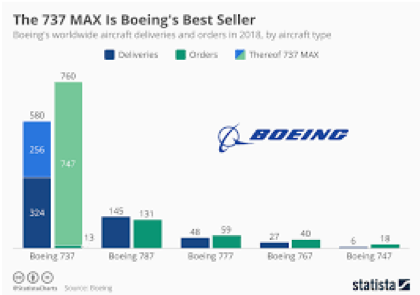
Statista Chart showing the importance of the 737 to Boeing’s revenue

The Boeing 737 contributes more than 50% of Boeing’s profits; this is only projected to rise in the future. There is a current order backlog of 5,012 737s, with only a few hundred in service. Currently, the Boeing 737 MAX is grounded worldwide as the industry awaits a thorough investigation and fix after the two deadly crashes. The world watches as revelations continue to surface from each incident.


References

https://www.cnbc.com/2019/03/20/buy-boeing-shares-because-the-737-max-is-too-big-to-fail-analyst-says.html

https://www.forbes.com/sites/greatspeculations/2019/04/08/boeing-has-cut-its-737-max-production-line-by-20-what-will-this-mean-for-revenue-and-the-stock/#6982f33947df


Facebook’s Response

In late December of 2016, Mark Zuckerberg laughed at the idea that Russian bots could have contributed to promoting a pro-Trump agenda via Facebook. However, fast forward to September 2017 and the CEO had agreed to provide the government with ads and ad information that were reportedly linked to the Internet Research Agency, a Russian “Hacker” agency located in St.Petersburg Russia who had reportedly been trying to target voters prior to the 2016 election. This information contributed to the Mueller probe that has come out within the past two months. So what exactly happened with these ads? And how were these ads used? The following data has been conducted by the Intelligence Community Assessment regarding efforts by the Internet Research Agency to reach Facebook users in 2015,2016 and 2017:

  • 3,519 Advertisement were purchased by the Internet Research Agency
  • More than 11.4 million Americans were exposed to these advertisements
  • 470 Internet Research Agency- created Facebook pages were collected
  • Organic Internet Research Agency content has reached over 126 million Americans

Here are some examples of the Ads created by the IRA in order to attract users to their pages.

While the exact goal of some of these posts may be unsure, one thing we can be sure about is that Facebook was facing an ethical dilemma in how exactly to respond to these ads and pages. The first of these reactions resulted in the created of Project P. Project P was an internal group put in place by Facebook officials to research these posts, the audience they are targeted towards, how to monitor these posts, and how to prevent these posts from occurring in the future. In April of 2017, Facebook released a document titled “Information Operations and Facebook” in which it discussed targeted data collection and false amplification. However, this document did not mention the specifics of the Russia-based Ads. However, just a year prior in April of the previous year, Facebook discussed three approaches it would take to diminishing the amount of false news spread on it’s platform. Facebook said it would eliminate economic incentives for ad- revenue based fake news pages. In addition it said it was creating new projects that work to verify page owners in order to authenticate pages, and finally create the Facebook Journalism Project in order to better inform users on how to gain information. Facebook also reported it had shut down 5.8 million fake accounts in October of 2016.

Perhaps the most important and comprehensive response to the interference of these Russian pages can be found within the testimony of CEO Mark Zuckerberg as he sat before Congress and answered questions about the topic on April 11th of 2018. Zuckerberg stated “We were too slow to spot and respond to Russian interference, and we’re working hard to get better.”. The CEO also mentioned that it is expected that an additional 20 million people were exposed to the Internet Research Agency created content on Instagram, another social media platform owned by Facebook. Below is the excerpt of Zuckerberg’s response when asked what they are doing to prevent the spread of this content.

Sources

An Introduction to Facebook

In the year 2019 Facebook needs no introduction, however Facebooks operations and business history may be less known. Let’s start with some basic information about Facebook. Facebook was founded in 2004 by CEO Mark Zuckerberg as well as colleagues Dustin Moskovitz and Eduardo Saverin while attending Harvard University. The company initially started as a way to connect students at Ivy League schools but quickly expanded outward and by 2006 had 12 million active users. Today Facebook calculates 1.52 billion daily active users, and has 35,587 employees. The company was number 76 on the 2018 Fortune 500 company list and is known as one of the “Big Four” technology companies. Facebook, within it’s mission statement and corporate culture statement, values the importance of making connections as well as valuing the ability of their users to share their opinions. Facebooks official website for news keeps their company information relatively short. A notable feature is it’s timeline which accents milestones like user count as well as events like taking the company public and purchasing Instagram.

On Facebooks newsroom, we can see that there has been a shift in the company over the last 5 years. Facebook faces new struggles in the modern age with things like privacy concerns and monitoring content posted to the site. In transition of what previous company attitudes were towards supposed fake accounts and accusations of influence in the political spectrum, Facebook is increasingly vocal in the news portion of their website, stressing how they work to eliminate fake accounts and improve ad transparency. On Facebooks news page right now there are multiple articles in reference to free speech and maintaining bipartisan attitudes in elections such as Preparing for Upcoming Indians and Australian Elections, Four Ways to Regulate the Internet, and Standing Against Hate. Many of these articles related to safety and inclusiveness have been posted just within the last month. It is clear that Facebook is shifting its tactics to focus on maintaining safety and removing damaging content. Facebook has been overall more vocal on all topics and is focusing more on transparency within the company.

Facebook values in relation to the topic of Russian hacking and protection of media can be a difficult approach for the company. Facebook strongly supports the ideas of their users to express opinions and make connections. One may ask, if “Hackers” or “Trolls” are simply expressing their own opinions, what right does Facebook have to intervene? It also begs the political leanings of Facebook into question as well. Facebook has supported various politicians in the past. Does this conflict with the values of the company?

Sources

Design a site like this with WordPress.com
Get started